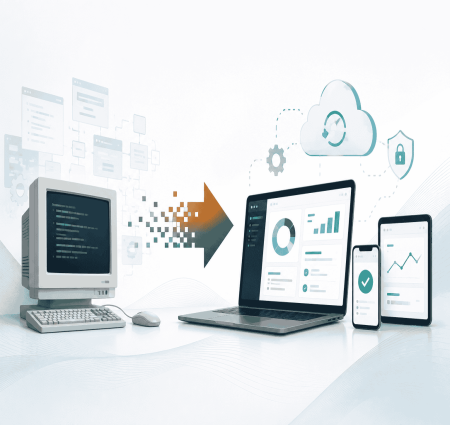
Full Stack Development Services New Jersey In the commercial centers of New York City and the technology and research hubs of Princeton, New Jersey, many established enterprises face a common challenge: decades of growth have left them dependent on aging software systems. These legacy applications may still support critical business processes, but many were not designed for today's expectations around scalability, security, integrations, user experience, cloud infrastructure, and rapid product development. As business requirements continue to evolve, organizations can find it increasingly difficult to adapt older applications without introducing additional technical complexity. For enterprises across New Jersey and the broader Tri-State region, this makes modernization more than a routine IT project. High maintenance costs, security concerns, limited integration capabilities, and dependence on outdated technologies can slow innovation and make it harder for businesses to respond quickly to changing market demands. As a result, adopting full stack development services in New Jersey has become an important strategy for organizations looking to modernize legacy applications while creating a stronger foundation for future growth. Rather than replacing everything at once, many enterprises are taking a phased approach to modernization. By combining modern frontend frameworks, API-first integrations, cloud infrastructure, scalable backend technologies, and incremental application refactoring, businesses can preserve valuable existing business logic while gradually moving toward a more flexible architecture. The Hidden Cost of Technical Debt in New Jersey Enterprises Legacy applications rarely become problematic overnight. Instead, technical debt often accumulates gradually as organizations add custom features, integrations, patches, and workarounds over many years. For businesses operating in competitive markets such as New Jersey and New York, this accumulated technical debt can create several challenges. Rising Maintenance Costs Older applications often require specialized knowledge that becomes increasingly difficult to find as technologies age. Organizations may need to spend more time and resources maintaining existing functionality instead of investing in new products, features, and digital initiatives. The problem becomes even more significant when only a small number of developers understand the application's original architecture or business logic. Limited Scalability Many legacy systems were designed around infrastructure and workloads that were very different from today's requirements. Increasing user traffic, larger datasets, new integrations, and expanding business operations can expose architectural limitations. A system that worked effectively for a smaller organization may struggle when transaction volumes, users, or data requirements increase. Integration Challenges Modern businesses rarely operate with a single application. CRM platforms, ERP systems, payment services, analytics platforms, cloud applications, mobile applications, and third-party services often need to communicate with one another. Legacy applications may not provide modern APIs or integration mechanisms, making it harder to connect them with newer technologies. Security and Compliance Risks Older applications can also create security challenges when their underlying frameworks, dependencies, authentication mechanisms, or infrastructure are no longer adequately maintained. Modernization provides an opportunity to introduce stronger authentication, authorization, encryption, monitoring, logging, dependency management, and security practices into the application architecture. Core Architectural Strategies for System Modernization Modernizing a legacy application does not always mean replacing the entire system. For many enterprises, a gradual modernization strategy can reduce risk while allowing the organization to continue operating its existing systems. The right approach depends on application complexity, business priorities, data dependencies, integration requirements, and the organization's long-term technology goals. The Strangler Fig Pattern The Strangler Fig Pattern is one approach commonly considered for incrementally modernizing large and complex applications. Instead of replacing the entire legacy system at once, development teams gradually introduce new functionality around the existing application. New services are created and deployed while selected functionality is progressively moved away from the legacy platform. An API gateway or routing layer can help direct requests between the existing system and newly developed services. This approach allows organizations to modernize specific capabilities in stages rather than taking on the risk of a single large-scale rewrite. API-First Integration Legacy applications often contain valuable business rules, workflows, and historical data that organizations cannot simply discard. An API layer can help expose selected functionality from an existing application so that modern interfaces and services can communicate with it. For example, a modern frontend built with React, Next.js, or Angular can communicate with backend functionality through REST or GraphQL APIs without requiring the entire legacy database and application to be replaced immediately. This creates a practical bridge between existing systems and modern digital experiences. Cloud-Native Full-Stack Architecture Cloud technologies can provide another path toward modernization. Organizations can gradually move selected application components into cloud environments and adopt architectures that support greater scalability, resilience, automation, and observability. Depending on project requirements, backend services can be developed using technologies such as Node.js, Python, Go, Java, or .NET and deployed through cloud platforms such as AWS, Azure, or Google Cloud. Microservices can also be considered where they provide a genuine architectural benefit. Rather than automatically converting every legacy application into microservices, organizations should evaluate whether separating specific business capabilities will improve scalability, maintainability, or deployment flexibility. A Phased Roadmap for Enterprise Modernization Successful modernization requires more than selecting a new programming language or cloud platform. It requires a structured approach that considers business requirements, technical dependencies, data, security, testing, and deployment. 1. Conduct a Comprehensive Architectural Audit Before modifying an existing application, development teams should understand how the system works. An architectural assessment can examine: Application components Code dependencies Databases and data relationships External integrations APIs Infrastructure Security controls Deployment processes Performance bottlenecks Critical business workflows Dependency mapping helps teams identify which components should be modernized first and which systems must remain operational during the transition. 2. Modernize the User Experience and API Layer The user-facing layer is often a practical starting point for modernization. A modern frontend can provide a better experience for employees and customers while communicating with existing backend functionality through well-defined APIs. Technologies such as React, Next.js, Angular, TypeScript, REST, and GraphQL can support the development of modern interfaces and integration layers. This approach can deliver visible improvements without requiring an immediate replacement of every backend component. 3. Refactor Business Logic Incrementally Once the application has a stronger frontend and integration layer, teams can begin addressing legacy business logic. Instead of rewriting every component simultaneously, developers can identify individual functions or business capabilities that are suitable for refactoring. Critical business rules should be carefully tested before and after migration to ensure that modernization does not unintentionally change how important business processes operate. 4. Modernize the Database and Data Architecture Data modernization is another important part of legacy transformation. Depending on the application, this may involve: Database optimization Schema redesign Data migration Database replication Cloud database adoption Data validation Backup improvements Performance optimization Database migration should be carefully planned because application functionality, reporting, integrations, and business processes may depend on existing data structures. 5. Introduce CI/CD and Automated Testing Modern applications benefit from automated development and deployment processes. Continuous integration and continuous delivery can help development teams identify problems earlier and release improvements more consistently. Automated testing can cover critical application functionality, APIs, integrations, and business logic before new versions reach production. A modernization program can also introduce automated security checks, code quality analysis, deployment automation, and rollback procedures. 6. Implement Monitoring and Observability Modernization should not end when new code reaches production. Monitoring and observability help engineering teams understand how applications behave in real-world environments. Useful capabilities can include: Application performance monitoring Centralized logging Infrastructure monitoring API monitoring Error tracking Database monitoring Security alerts Performance metrics These capabilities help teams identify problems earlier and make informed decisions about future optimization. Why Full-Stack Development Matters for Legacy Modernization Legacy modernization often requires changes across multiple layers of an application. A modern frontend alone cannot solve backend architecture problems. Likewise, replacing a backend without addressing APIs, databases, user experience, deployment, and infrastructure may leave organizations with the same underlying limitations. Full-stack development brings these layers together. A modernization-focused full-stack team may work across: Frontend applications Backend services APIs and integrations Databases Cloud infrastructure Authentication and authorization DevOps Automated testing Monitoring and observability This end-to-end perspective can make it easier to coordinate modernization efforts and ensure that changes across different application layers work together effectively. Frequently Asked Questions What is legacy system modernization? Legacy system modernization is the process of improving or transforming an existing software application so that it can support modern business, technical, security, scalability, and integration requirements. Depending on the application, modernization can involve refactoring code, replacing components, updating frameworks, introducing APIs, migrating databases, adopting cloud infrastructure, or rebuilding selected services. Should an enterprise completely rewrite or incrementally modernize its legacy application? The answer depends on the application's condition, complexity, business importance, and modernization goals. A complete rewrite can make sense when an existing system is fundamentally unsuitable for future requirements. However, incremental modernization can reduce risk when the existing application contains valuable business logic and must remain operational. Many enterprises therefore evaluate modernization component by component instead of automatically choosing a complete rewrite. How can enterprises reduce downtime during modernization? Organizations can reduce disruption by using phased deployments, API gateways, parallel environments, automated testing, database replication, feature flags, blue-green deployments, and carefully planned migration procedures. The appropriate strategy depends on the application's architecture and business-critical requirements. What technologies can be used for full-stack modernization? Technology selection depends on the project's requirements. Common technologies include React, Next.js, Angular, TypeScript, Node.js, Python, Java, .NET, REST, GraphQL, SQL databases, NoSQL databases, Docker, Kubernetes, AWS, Azure, and Google Cloud. The goal should not be to select the newest technology simply because it is popular. The technology stack should support the organization's scalability, security, integration, maintenance, and business requirements. How long does legacy application modernization take? There is no universal timeline. A smaller modernization initiative may take several months, while a large enterprise application involving multiple systems, databases, integrations, and business processes may require a much longer phased program. The timeline depends on application size, technical debt, dependencies, migration complexity, testing requirements, team capacity, and business priorities. Can legacy applications be modernized without replacing the entire system? Yes. Incremental modernization allows organizations to replace or improve selected parts of an application while continuing to operate the existing system. This can be particularly useful when the legacy application contains important business rules or data that cannot easily be replaced. Building a Scalable Foundation for the Future Modernizing a legacy application is not simply a technology upgrade. It is an opportunity to create a stronger foundation for future business growth. For enterprises in New Jersey and the broader Tri-State region, modern full-stack architecture can help address the limitations of aging applications while creating opportunities for better user experiences, improved integrations, greater scalability, and more efficient development. A thoughtful modernization strategy allows organizations to preserve valuable business knowledge while gradually introducing modern technologies and development practices. Rather than treating legacy software as an obstacle that must be discarded, enterprises can approach modernization as a structured evolution of their technology environment. CAT Software Services Inc. helps businesses modernize existing applications and build scalable digital systems across frontend development, backend engineering, API integration, cloud application development, enterprise applications, and legacy application modernization. Organizations evaluating modernization can begin by assessing their current architecture, identifying technical dependencies, prioritizing business-critical components, and establishing a phased roadmap for transformation. With the right strategy and engineering approach, legacy applications can become a foundation for continued innovation rather than a barrier to growth.
Read Full Blog