Company Logo

English

WEFRU4084211906202
Scan to visit website

Scan QR code to visit our website

Blog by English | Digital Diary

" To Present local Business identity in front of global market"

Meri Kalam Se
Digital Diary Submit Post English

A QUESTION OF TRUST

A QUESTION OF TRUST
A QUESTION OF TRUST EVERYONE thought that Horace Danby was a good, honest citizen. He was about fifty years old and unmarried, and he lived with a housekeeper who worried over his health. In fact, he was usually very well and happy except for attacks of hay fever in summer. He made locks and was successful enough at his business to have two helpers. Yes, Horace Danby was good and respectable - but... Read More
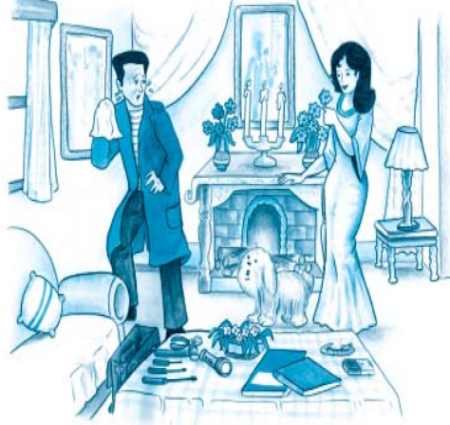
A QUESTION OF TRUST EVERYONE thought that Horace Danby was a good, honest citizen. He was about fifty years old and unmarried, and he lived with a housekeeper who worried over his health. In fact, he was usually very well and happy except for attacks of hay fever in summer. He made locks and was successful enough at his business to have two helpers. Yes, Horace Danby was good and respectable - but not completely honest. Fifteen years ago, Horace had served his first and only sentence in a prison library. He loved rare, expensive books. So he robbed a safe every year. Each year he planned carefully just what he would do, stole enough to last for twelve months, and secretly bought the books he loved through an agent. Now, walking in the bright July sunshine, he felt sure that this year's robbery was going to be as successful as all the others. For two weeks he had been studying the house at Shotover Grange, looking at its rooms, it's electric wiring, it's paths and it's garden. This afternoon the two servants, who remained in the Grange while the family was in London, had gone to the movies. Horace saw them go, and he felt happy in spite of a little tickle of hay fever in his nose. He came out from behind the garden wall, his tools carefully packed in a bag on his back. There were about fifteen thousand pounds' worth of jewels in the Grange safe. If he sold them one by one, he expected to get at least five thousand, enough to make him happy for another year. There were three very interesting books coming up for sale in the autumn. Now he would get the money he wanted to buy them. He had seen the housekeeper hang the key to kitchen door on a hook outside. He put on a pair of gloves, took the key, and opened the door. He was always careful not to leave any fingerprints. A small dog was lying in the kitchen. It stirred, made a noise, and moved its tail in a friendly way. "All right, Sherry, " Horace said as he passed. All you had to do to keep dogs quiet was to call them by their right names, and show them love. The safe was in the drawing room, behind a rather poor paintimg. Horace wondered for a moment whether he should collect pictures instead of books. But they took up too much room. In a small house, books were better. There was a great bowl of flowers on the table, and Horace felt his nose tickle. He gave a little sneeze and then put down his bag. He carefully arranged his tools. He had four hours before the servants returned. The safe was not going to be hard to open. After all, he had lived with locks and safes all his life. The burglar alarm was poorly built. He went into the hall to cit it's wire. He came back and sneezed loudly as the smell of the flowers came to him again. How foolish people are when they own valuable things , Horace thought. A magazine article had described this house, giving a, plan of all the rooms and a picture of  this room. The writer had even mentioned that the painting hid a safe! But Horace found that the flowers were hindering him in his work, He buried his face in his handkerchief. Then he heard a voice say from the doorway, "what is it? A cold or hay fever? " Before he could think, Horace said, "Hay fever, " and found himself sneezing again. The voice went on, "You can cure it with a special treatment, 
Read Full Blog
[email protected] 29 Sep 2026 21 Views

THE SERMON AT BENARES

THE SERMON AT BENARES GAUTAMA Buddha [563B. C.- 483B. C. ] began life as a prince named Siddhartha Gautama, in northern India. At twelve, he was sent away  for schooling in the Hindu sacred scriptures and four years later he returned home to marry a princess. They had a son and lived for ten years as befitted royalty. At about the age of twenty - five, the prince, heretofore shielded from  the suf... Read More
THE SERMON AT BENARES GAUTAMA Buddha [563B. C.- 483B. C. ] began life as a prince named Siddhartha Gautama, in northern India. At twelve, he was sent away  for schooling in the Hindu sacred scriptures and four years later he returned home to marry a princess. They had a son and lived for ten years as befitted royalty. At about the age of twenty - five, the prince, heretofore shielded from  the sufferings of the world, while out hunting chanced upon a sick man, then an aged man, then a funeral procession, and finally a monk begging for alms. These sights so moved him that he at once went out into the world to seek enlightenment concerning the sorrows he had witnessed. He wandered for seven years and finally sat down under a peepal tree, where he vowed to stay until enlightenment came. Enlightened after seven days, he ranamed the tree the Bodhi Tree [Tree of Wisdom] and began to teach and to share his new understandings. At that point he became known as the Buddha [the Awakened or the Enlightened] . The Buddha preached his first sermon at tha city of Benares, most holy of the dipping places on the River Ganges; that sermon has been preserved and is given here. It reflects the Buddha's wisdom about one inscrutable kind of suffering. Kisa Gotami had an only son, and he died. In her grief she carried the dead child to all her neighbours, asking them for medicine, and the people said, "She has losk her senses. The boy is dead. " At length, kisa Gotami met a man who replied to her request, "I cannot give thee medicine for thy child, but I know a physician who can. " And the girl said, "Pray tell me, sir; who is it? " And the man replied, "Go to sakyamunt, the Buddha. " Kisa Gotami repaired to the Buddha and cried, "Lord and Master, give me the medicine that will cure my boy. " The Buddha added, "The mustard- seed must be taken from a house where no one has lost a child, husband, parent or friend. " Poor kisa Gotami now went from house to house, and the people pitied her and said, Here is mustard-seed; take it! " But when she asked, "Did a son Or daughter, a father or mother, die in your family? " they answered her, "Alas! the living are few, but the dead are many. Do not remind us of our deepest grief. " And there was no house but some beloved one had died in it. Kisa Gotami become weary and  hopeless, and sat down at the wayside watching the lights of the city, as they flickered up and were extinguished again. At last the darkness of the night reigned everywhere. And she considered the fate of men, that their lives flicker up and are extinguished again. And she thought to herself, "How selfish am I in my grief! Death is comman to all; yet in this valley of desolation there is a path that leads him to immortality who has surrendered all selfishness. " The Buddha said, "The life of mortals in this world is troubled and brief and combined with pain. For there is not any means by which those that have been born can avoid dying; after reaching old age there is death;of such a nature are living beings. As ripe fruits are early in danger of falling, so mortals when bron are always in danger of death. As all earthen vessels made by the Potter and in being broken, so is the life of mortals. Both young and adult, both those who are fools and those who are wise, all fall into the power of death; all are subject to beath. "Of those who, overcome by death, depart from life, a father cannot save his son, nor kinsmen their relations. Mark! while relatives are looking on and lamenting deeply, one by one mortals are carried off, like an ox that is led to the slaughter. So the world is afflicted with death and decay, therefore the wise do not grieve, knowing the terms of the world. "Not from weeping nor from grieving will anyone obtain peace of mind; on the contrary, his pain will be the greater and his body will suffer. He will make himself sick and pale, yet the dead are not saved by his lamentation. He who seeks peace should draw out the arrow of lamentation, and complaint, and grief. He who has drawn out the arrow and has become composed will obtain peace of mind; he who has overcome all sorrow will become free from sorrow, and be blessed. "
Read Full Blog
[email protected] 25 Sep 2026 45 Views

MADAM RIDES THE BUS

MADAM RIDES THE BUS PART=I THERE was a girl named Valliammai who was called valli for short. She was eight years old and very curious about things. Her favourite pastime was standing in the front doorway of her house, watching what was happening in the street outside. There were no playmates of her own age on her street., and this was about all she had to do. But for valli, standing at the front d... Read More
MADAM RIDES THE BUS PART=I THERE was a girl named Valliammai who was called valli for short. She was eight years old and very curious about things. Her favourite pastime was standing in the front doorway of her house, watching what was happening in the street outside. There were no playmates of her own age on her street., and this was about all she had to do. But for valli, standing at the front door was every bit as enjoable as any of the elaborate games other children played. Watching the street gave her many new unusual experiences. The most fascinating things of all was the bus that travelled between her village and the nearest town. It passed through her street each hour, once going to the bus, filled each time with a new set of passengers, was a source of unending joy for valli . Day after day she watched the bus., and gradually a tiny wish crept into her head and grew there: she wanted to ride on that bus, even if just once. This wish become stronger and stronger, until it was an overwhelming desire. Valli would stare wistfully at the people who got on or off the bus when it stopped at the street corner. Their faces would kindle in her longings, dreams, and hopes, If one of her friends happened to ride the bus and tried to describe the sights of the town to her, Valli would be too jealous to listen and would shout, in English: "proud! proud! " Neither she nor her friends really undersrood the meaning of the word, but they used it often as a slang expression of disapproval. Over many days and months Valli listened carefully to  conversations between her neighbours and people who regularly used the bus, and she also asked a few discreet questions here and there. This way she picked up various small details about the bus journey. The town was six miles from her village. The fare was thirty paise one way--"which is almost nothing at all, " She heard one well-dressed man say, but to Valli, who scareely saw that much money from one month to the next. It seemed a fortune. The trip to town took forty-five minutes. On reaching town, if she stayed in her seat and paid another thirty paise, she could return home on the same bus. This meant that she could take the one-o' clock afternoon bus, reach the town at one forty-five, and be back home by the town at one forty-five, and be back home by about two forty-five... On and an went her thoughts as she calculated and recalcuated, planned and replanned.  PART=II Well, one fine spring day the afternoon bus was just on the point of leaving the village and turning into the main highway when a small voice was heard shouting: "stop the bus! " And a tiny hand was raised commandingly. The bus slowed down to a crawl, and the conductor, stiching his head out the door, said. "Hurry then! Tell whoever it is to come quickly. " "It's me, " shouted Valli. "I'm the one who has to get on. " By now the bus had come to a stop, and the conductor said, "Oh, really! You don't say so! "" Yes, I simply have to go to town, " said Valli, still standing outside the bus, "and here's my money. " She showed him some conis. "Okay, okay, but first you must get on the bus, " said the conductor, and he stretched out a hand to help her up. "Never mind, " she said, "I can get on by myself. You don't have to help me. " The conductor was a jolly sort, fond of joking, "Oh, please don't be angry with me, my fine madam, " he said. "Here, have a seat right up there in front. Everybody move aside please----make way for madam. " It was the slack time of day, and there were only six or seven passengers on the bus. They were all looking at Valli and laughing with the conductor. Valli was overcome with shyness. Avoinding everyone's eyes, she walked quickly to an empty seat and sat down. "May we start now, madam? " the conductor asked, smiling. Then he blew his whistle twice, and the bus moved forward with a roar. It was a new bus, it's outside painted a gleaming white with some green stripes along the sides. Inside, the overhead bars shone like silver. Directlt in front of Valli, above the windshield, there was a beautiful clock. The seats were soft and luxurious. Valli devoured everything with her eyes. But when she started to look outside, she found her view cut off by a canvas blind that covered the lower part of her window. So she stood up on the seat and peered over the blind. The bus was now going along the bank of a canal. The road was very narrow. On one side there was the canal and, beyond it, palm trees, grassland, distant mountains, and the blue, blue sky. On the other side was a deep ditch and then acres and acres of green fields---green, green, as far as the eye could see.p Oh, it was all so wonderful! Suddenly she was startled by a voice. "Listen, child, " said the voice, "you shouldn't stand like that. Sit down. " Sitting down, she looked to see who had spoken. It was an elderly man who had honestly been concerned for her, but she was annoyed by his attention. "There's nobody here who's a child. " She said haughtily. "I've paid my thirty paise like everyone else. " The conductor chimed in. "Oh, sir, but this is a very grown-up madam. Do you think a mere girl could pay her own fare and travel to the city all alone? " Valli shot an angry glance at the conductor and said, "I am not a madam. Please remember that. And you've not yet given me my ticket. " "I'll remember, " the conductor said, mimicking her tone. Everyone laughed, and gradually Valli too joined in the laughter. The conductor punched a ticket and handed it to her. "Just sit back and make yourself comfortable. Why should you stand whan you've paid for a seat? " "Because I want to, " she answered, standing up again. "But if you stand on the seat, you may fall and hurt yourself when the bus makes a sharp turn or hits a bump. That's why we want you to sit down, child. " I'm not a child, I tell you, "she said irritably. " I'am eight years old. " "Of course, of course. How stupid of me! Eight years---my! " The bus stopped, some new passengers got on, and the conductor got busy for a time. Afraid of losing her seat, Valli finally sat down. Valli found the woman absolutely repulsive ----- such big holes she had in her ear lobes, and such ugly earrings in them! And she could smell the betel nut the woman was chewing and see the betel juice that was threatening to spill over her lips at any moment. Ugh! who could be sociable with such a person? "Yes, I'm travelling alone, " she answered curtly. "And I've got a ticket too. " "Yes, she's on her way to town, " said the conductor. "With a thirty-paise ticket. " "Oh, why don't you mind your own business, " said Valli. But she laughed all the same, and the conductor laughed too. But the old woman went on with her drivel. "Is it proper for such a young person to travel alone? Do you know exactly where you're going in town? What's the street? What's the house number? " "You needn't bother about me. I can take eare of myself, " Valli said, turning her face towards the window and staring out. 
Read Full Blog

[email protected] 18 Sep 2026 96 Views

COORG

COORG MIDWAY batween Mysore and the coastal town of Mangalore sits a piece of heaven that must have drifted from the kingdom of gad. This land of rolling hills is inhabited by a proud race of martial men, beautiful woman and wild creatures. Croog, or kadagu, the smallest district of karnataka, is home to evergreen rainforests cover thirty per cent of this district. During the monsoons, it pours en... Read More
COORG MIDWAY batween Mysore and the coastal town of Mangalore sits a piece of heaven that must have drifted from the kingdom of gad. This land of rolling hills is inhabited by a proud race of martial men, beautiful woman and wild creatures. Croog, or kadagu, the smallest district of karnataka, is home to evergreen rainforests cover thirty per cent of this district. During the monsoons, it pours enough to keep many visitors away. The season of joy commences from September and continues till March. The weather is perfect, with some showers thrown in for good measure. The air breathes of invigorating coffee. Coffee estates and colonial bungalows stand tucked under tree canopies in prirne corners. The fiercely independent people of coorg are possibly of Greek or Arabic descent. As one story goes, a part of Alexander's army moved South along the coast and settled here when return become important. These people married amongst the locals and their culture is apparent in the martial traditions, marriage and religions rites, which are distinct from the hindu mainstream. The theory of Arab orgin draws support from the long. black coat with an embroidered waist-belt worn by the kodavus. Know as kuppia, it resembles the kuffia worn by the Arabs and the kurds. Coorgi homes have a tradition of hospitality, and they are more than willing to recount numerous tales of valour related to their sons and father. The coorg Regiment is one of the most decorated in the Indian Army, and the first chief of the Indian Army General cariappa, was a coorgi. Even now, Kodavus are the only people in India permitted to carry firearms without a licence. The river, Kaveri, obtains it's water from the hills and forests of coorg. Mahaseer--a large fresh--abound in these waters. Kingfishers dive for their catch, while squirrels and langurs drop partially eaten fruit for the mischief of enjoying the splash and the ripple effect in the clear water. Elephants enjoy being bathed and scrubbed in the river by their mahouts. The most laidback individuals become converts to the life of high-energy adventure with river rafting, canoeing, rappelling, rock climbing and momountain baking. Numerous walking trails in this region are a favourite with trekkers. Birds, bees and butterflies are there to give you company. Macaques, Malabar squirrels, langurs and slender loris keep a watchful eye from the tree canopy. I do, however, prefer to step aside for wild elephants. The climb to the Brahmagiro hills brings you into a panoramic view of the entire misty landscape of coorg. A walk across the rope bridge leads to the sixty-four-acre island of Nisargadhama. Running into Buddhist monks from India's largest Tibetan monks, in red, ochre and yellow robes, are amongst the many surprises that wait to be discovered by visitors searching for heart and soul of India, right here in coorg. 
Read Full Blog
[email protected] 17 Sep 2026 95 Views

Mijbil the Otter

MIJBIL THE OTTER Early in the new year of 1956 I travelled to southern iraQ. By then iyt hads crossed my mind that i should like to keep an otter instead of a dog and that camusfearna ringed by water a stone's throw from its door would be an eminently suitable spot for this experiment. When I casually mentioned this to a friend he as casually replied that i had better get one in the Tigris mar... Read More
MIJBIL THE OTTER Early in the new year of 1956 I travelled to southern iraQ. By then iyt hads crossed my mind that i should like to keep an otter instead of a dog and that camusfearna ringed by water a stone's throw from its door would be an eminently suitable spot for this experiment. When I casually mentioned this to a friend he as casually replied that i had better get one in the Tigris marshes for there they were as common as mosquitoes and were ofter tamed by the Arabs. We weree going to Basra to the consulate - General to collect and answer our mail from Europe. at the consulate general we found that my friend mail had arrived but that mine had not. I cabled to England, and when, three days later, nothing had happened. I tried to telephone. The call had to be booked twenty-four hours in advance. On the first day the line was out of order;on the second the exchange was closed for a religious holida. On the third day there was another breakdown. My friend left, and I arranged to meet him in a week's time. Five days later, my mill arrived. I carried it to my bedroom to read, and there, squatting on the floor, were two Arabs; beside them lay a sack that squirmed from time to time. They handed mphaqqote from my friend: "Here is your otter... "
Read Full Blog
[email protected] 16 Sep 2026 97 Views

A BAKER FROM GOA

A BAKER FROM GOA
A BAKER FROM GOA Our elders are often heard reminiscing nostalgically about those good old portuguese days, the portuguese and their fomous loaves of bread. Those eaters of loaves might have vanished but the makers are still there. We still have amongst us the mixers, the moulders and those who bake the loaves. Those age-olg, time-tested furnaces still exist. The fire in the furnaces has not yet b... Read More
A BAKER FROM GOA Our elders are often heard reminiscing nostalgically about those good old portuguese days, the portuguese and their fomous loaves of bread. Those eaters of loaves might have vanished but the makers are still there. We still have amongst us the mixers, the moulders and those who bake the loaves. Those age-olg, time-tested furnaces still exist. The fire in the furnaces has not yet been extinguished. The thud and jingle of the traditional baker's bamboo, heralding his arrival in the morning. Can still be heard in some places. Maybe the father is not alive but the son still carries on the family profession. These bakere are, even today, know as pader in Goa. During our childhood in Goa, the baker used to be our friend, companion and guide. He used to come at least twice a day. Once, when he set out in the morning on his selling round, and then again, when he returned after emptying his hge basket. The jingline thud of his bamboo woke us up from sleep and we ran to meet and greet him. Why was it so? Was it for the love of the loaf? Not at all. The loaves were bought by some Paskine or Bastine, the maid-servant of the house! What we longed for were those bread-bangles which we chose carefully. Sometimes it was sweet bread of special make. The baker made his musical entry on the scene with the 'jhang, jhang' sound of his specially made bamboo staff. One hand supported the basket on his head and the other banged the bamboo on the ground. He would greet the lady of the house with "Good morning" and then place his basket on the vertical bamboo. We kids would be pushed aside with a mild rebuke and the loaves would be delivered to the servent. But we Would not give up. We would climb a bench or the parapet and peep into the basket, somehow. I can still recall the typical fragrance of those loaves. Loaves for the elders and the bangles for the children. Then we did not even care to brush our teeth or wash our mouths properly. And why should we? Who would take the trouble of plucking the mango-leaf for the toothbrush? And why was it necessary at all? The tiger never brushed his teeth. 
Read Full Blog
[email protected] 15 Sep 2026 127 Views

THE TREES

THE TREES
THE TREES The trees inside are moving out into the forest,   the forest that was empty all these days Where no bird could sit no sun bury its feet in shadow the forest that was empty all these nights will be full of trees by morning.  All nigh the roots work to disengaeg themselves from the cracks in the veranda floor.  The leaves strain toward the glass  small twigs stiff with exertiin long-cramp... Read More
THE TREES The trees inside are moving out into the forest,   the forest that was empty all these days Where no bird could sit no sun bury its feet in shadow the forest that was empty all these nights will be full of trees by morning.  All nigh the roots work to disengaeg themselves from the cracks in the veranda floor.  The leaves strain toward the glass  small twigs stiff with exertiin long-cramped boughs shuffling under the roof like newly discharged patients half-dazed, moving to the clinic doors.  I sit inside, doors open to the veranda writing long letters in which I scarcely mention the departure of the forest from the house.  The night is fresh, the whole moon shines in a sky still open the smell of leaves and lichen still reaches like a voice into the rooms.  My head is full of whispers which tomorrow will be breaking.  The trees are stumbling forward into the night. Winds rush to meet them.  The moon is broken like a mirror,  it's pieces flash now in the crown of the tallest oak. 
Read Full Blog
[email protected] 14 Sep 2026 119 Views

TEA FROM ASSAM

TEA FROM ASSAM
TEA FROM ASSAM "CHai-GARAM.... garam-chai, " a vendor called out in a high-pitched voice. He came up to their window and asked. "Chai, sa'ab? " "Give us two cups. " Pranjol said. They sipped the steaming hot liquid. Almost everyone in their compartment was drinking tea too. "Do you know that over eighty crore cups of tea are drunk every day throughout the world? " Rajvir said. "Whew! " exclaim... Read More
TEA FROM ASSAM "CHai-GARAM.... garam-chai, " a vendor called out in a high-pitched voice. He came up to their window and asked. "Chai, sa'ab? " "Give us two cups. " Pranjol said. They sipped the steaming hot liquid. Almost everyone in their compartment was drinking tea too. "Do you know that over eighty crore cups of tea are drunk every day throughout the world? " Rajvir said. "Whew! " exclaimed Pranjol. "Tea really is very popular. " The train pulled out of the station. Pranjol buried his nose in his detective book again. Rajvir too was an ardent fan of detective stories, but at the moment he was keener on looking at the beautiful scenery. It was green, green everywhere. Rajvir had never seen so much greenery before. Then the soft green paddy fields gave way to tea bushes.  It was a magnificent view. Against the backdrop of densely wooded hills a sea of tea bushes stretched as far as the eye could see. Dwarfing the tiny teaplants were tell sturdy shade-trees and amidst the orderly rows of bushes busily moved doll-like figurs. In the distance was an ugly bullinding with smoke billowing out of tall chimneyes. "Hey, a tea garden! " Rajvir cried excitedly, Prnjol, Who had been bron and brought up on a plantation, didn't share Rajvir's excitement. "Oh, this is tea country now, " he said. "Assam has the largest concentration of plantations in the world. You will see enough gardens to last you a lifetime! " "I have been reading as much as I could about tea,  " Rajvir said,. "No one really knows who discovered tea but there are many legends. " What legends? " "Well, there's the one about the Chinese emperor who always boiled water before drining under the pot fell into the water giving it a delicious flavour. It is asid they were tea leaves. " "Tell me another! " Scoffed Pranjol. "We have an Indian legend too. Bodhidharma, an ancient Buddhist ascetic, cut off his eyelids because he felt sleepy during meditations. Ten tea plants grew out of the eyelids. The leaves of these plants when put ni hot water and drank in China, " Rajvir added, "as far back as 2700 B. C.! In fact words such as tea. " Chai" and "chini" are from Chinese. Tea come to Europe only in the sixteenth century and was durnk more as medicine than as medicine than as beverage. " The train clattered into Mariant junction. The boys callected their luggage and pushed their way to the crowded platform. 
Read Full Blog
[email protected] 13 Sep 2026 134 Views

THE PANTHER

THE PANTHER His vision, from the constantly passing bars.  has grown so weary that it cannot hold anything else. It seems to him there are a thousand bars;and behind the bars, no world.  As he paces in cramped circles,  over and over,  the movement of his powerful soft strides  is like a ritual dance around a centre  In which a mighty will stands paralysed.  Only at times. the curtain of the pupil... Read More
THE PANTHER His vision, from the constantly passing bars.  has grown so weary that it cannot hold anything else. It seems to him there are a thousand bars;and behind the bars, no world.  As he paces in cramped circles,  over and over,  the movement of his powerful soft strides  is like a ritual dance around a centre  In which a mighty will stands paralysed.  Only at times. the curtain of the pupils lifts, quietly. An image enters in.  rushes down through the tensed, arrested muscles,  plunges into the heart and is gune.         
Read Full Blog
[email protected] 11 Sep 2026 112 Views

FOG

FOG
FOG The fog comes On little cat feet.  It sits looking Over harbour and city On silent  haunches And then moves on.    Read More
FOG The fog comes On little cat feet.  It sits looking Over harbour and city On silent  haunches And then moves on.   
Read Full Blog
[email protected] 11 Sep 2026 120 Views

Blog Catgories