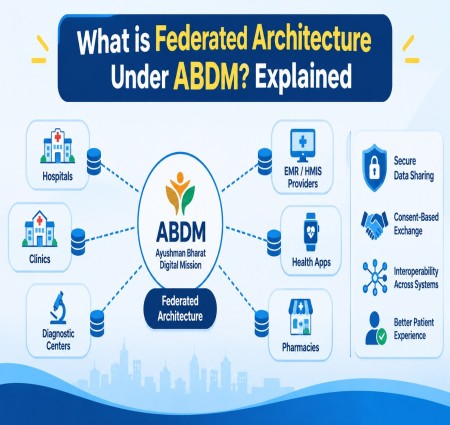
What is Federated Architecture Under ABDM?
If you have ever changed hospitals, you know the drill. New clinic, new file, and the same old question: "Do you have your previous reports?" You dig through a bag of printouts, scroll through WhatsApp for a scan, and hope nothing is missing.
India's Ayushman Bharat Digital Mission (ABDM) is trying to fix exactly this. And the idea at the heart of it is something called federated architecture. The term sounds technical, but the concept is surprisingly simple. This post explains it in plain language: what it is, how it works, and why it matters for patients, doctors and health-tech builders.
What is ABDM?
The Ayushman Bharat Digital Mission is a national initiative run by the National Health Authority (NHA). Its goal is to build a connected digital health ecosystem where your health records can move safely between hospitals, labs, pharmacies and apps, but only when you allow it.
To make that possible, ABDM provides a few building blocks:
ABHA (Ayushman Bharat Health Account) number: A unique 14-digit health ID for every citizen who opts in.ABHA address: A human-friendly handle (like yourname@abdm) used to log in and share records.Health Facility Registry (HFR) and Healthcare Professionals Registry (HPR): Verified directories of hospitals, clinics, doctors and other providers.Consent manager and gateway: The layer that asks for your permission and routes requests securely.
Federated architecture is the design choice that ties all of these together.
What is Federated Architecture?
In a centralised system, all data is copied into one giant database. Everyone sends their records there, and everyone queries it from there.
In a federated system, the data stays where it was created. Your blood test report remains with the lab that produced it. Your discharge summary stays with the hospital. Instead of moving everything into one place, the system creates a secure network that lets these separate databases talk to each other on request.
A simple analogy: think of a library network. Each library keeps its own books, but a shared catalogue tells you where a book is and lets you borrow it from another branch. ABDM works the same way, except the "books" are your health records and you decide who may borrow them.
How does federated architecture work under ABDM?
Here is the typical flow, step by step.
1. Records are created and stored at the source. When you visit a hospital or lab, your records are saved in that provider's own system. These providers are called Health Information Providers (HIPs). ABDM does not make a central copy.
2. Records are linked to your ABHA. The provider links your visit (called a "care context") to your ABHA number or address. Only a reference is shared, not the full record.
3. Someone requests access. A doctor or app that wants to see your history is called a Health Information User (HIU). They raise a request through the ABDM gateway, stating what they need and why.
4. You give consent. You get a notification in your PHR app (such as the ABHA app). You can approve or deny, choose which record types to share, and set how long access lasts. This creates a digital consent artefact.
5. Data flows directly and securely. Once consent is granted, the HIP sends the records straight to the HIU in encrypted form. The ABDM gateway helps with routing and verification, but it does not store your health data.
6. Access expires. When the consent period ends, the HIU's permission ends too. You can also revoke consent at any time.
Who are the key players?
Patient (you): The owner of the data and the one who gives or withholds consent.HIP (Health Information Provider): Hospitals, labs, clinics and pharmacies that hold your records.HIU (Health Information User): Doctors, apps or insurers who request records with your permission.Consent manager: Manages and records your consent decisions.ABDM gateway: The secure intermediary that connects everyone without holding the data.PHR apps: Apps like the ABHA app where you view, manage and share your records.
Why did ABDM choose a federated model?
There are solid reasons behind this choice.
Privacy by design. With no single giant database, there is no single jackpot for attackers. A breach at one provider does not expose the entire country's health data.
Patient control. Consent is built into every exchange. Nothing moves without your approval, which fits well with the principles of India's Digital Personal Data Protection Act 2023.
Scalability. India has lakhs of facilities, from large corporate hospitals to small rural clinics. A federated model lets each keep its own systems and join the network gradually, rather than forcing everyone onto one platform.
Interoperability through standards. Because records come from different systems, ABDM relies on common standards such as HL7 FHIR for data format and terminologies like SNOMED CT and LOINC, so one system can understand another's data.
Less duplication, lower cost. Providers do not need to re-upload everything to a central server, and patients avoid repeat tests.
What does this mean for different people?
For patients: One ID, one place to view records from many providers, and full control over who sees them.
For doctors: A faster, more complete view of a patient's history, which helps with better decisions and fewer repeated investigations.
For hospitals and labs: A way to join a national network without giving up ownership of their data.
For health-tech developers: Open, standards-based APIs and a sandbox environment to build and test apps that plug into the ecosystem.
Challenges worth knowing about
No system is perfect. Federated architecture depends on providers actually digitising their records and linking them to ABHA. Adoption varies across states and facility sizes, internet connectivity can be patchy in some areas, and awareness among patients is still growing. Data quality also differs from one provider to another. These are real hurdles, and ABDM's rollout is still maturing.
Final thoughts
Federated architecture is what makes ABDM different from a plain "national health database." Your records stay where they were created, they travel only with your consent, and they move over secure, standardised channels. For patients it means control. For providers it means flexibility. For the country it means a health system that can finally connect the dots without putting everything in one basket.
If you are a patient, creating an ABHA number is the first step. If you are a provider or developer, the ABDM sandbox is the place to start.
Frequently Asked Questions (FAQs)
Q1. What is federated architecture in simple words?
A1. It is a system design where data stays with the organisation that created it, and a secure network lets different systems share information on request. Nothing is copied into one central database.
Q2. Does ABDM store my health records in a central database?
A2. No, ABDM does not keep a central repository of your medical records. Records remain with hospitals, labs and other providers. The ABDM network only helps locate, request and securely route them with your consent.
Q3. What is the difference between centralised and federated architecture?
A3. A centralised system collects all data into one place. A federated system leaves data at its source and connects systems through a common layer. Federated models generally offer better privacy and scale more easily across many independent providers.
Q4. Who owns my health data under ABDM?
A4. You do. The system is built around the principle that the patient controls access. Providers hold the records, but they can share them only after you approve a consent request.
Q5. What are HIP and HIU in ABDM?
A5. HIP stands for Health Information Provider, such as a hospital or lab that holds your records. HIU stands for Health Information User, such as a doctor, app or insurer that requests those records, with your consent, for care or services.
Q6. How does consent work in ABDM's federated model?
A6. An HIU raises a request through the gateway. You receive it in your PHR app and can approve or reject it, choose which records to share and set an expiry date. You can revoke consent later whenever you wish.
Q7. Is my data safe in a federated system?
A7. Federated design reduces risk because there is no single large database to attack. Data is shared in encrypted form and only after consent. That said, security also depends on how well each provider protects its own systems.
Q8. Why does ABDM use standards like FHIR?
A8. Because records come from many different software systems. Common standards such as HL7 FHIR let these systems exchange data in a format everyone understands, so a report from one hospital can be read properly by another.
Q9. Do I need an ABHA number to benefit from this architecture?
A9. Yes, ABHA is the key that links your records across providers. Creating one is voluntary and free, and it is what allows you to view and share your health history through the network.
Q10. Can small clinics and labs join the ABDM network?
A10. Yes, Because the model is federated, even small facilities can keep their existing systems and integrate over time. They can register in the Health Facility Registry and connect using ABDM's standard APIs, with sandbox support for testing.
Read Full Blog