Engineering Education in Madurai: Understanding the Options Beyond the Course Name
꧁ Digital Diary ༒ Wefru – India's Largest Writing Community ༒ Read, Write & Grow ༒꧂

꧁ Digital Diary ༒ Wefru – India's Largest Writing Community ༒ Read, Write & Grow ༒꧂
Scan QR code to visit our website

Choosing an engineering programme is often treated as a simple matter of selecting a branch from a list. In reality, every branch introduces a different way of looking at problems. Some deal with physical structures, some with machines and electrical systems, while others work with software, data, electronic devices or intelligent systems.
For students exploring Madurai Engineering College options, understanding these differences can make course research more meaningful. A programme title gives only a broad idea. The subjects inside it, the type of work involved and the areas it connects with provide a much clearer picture.
The word "engineering" covers a wide range of technical fields.
Civil Engineering is closely connected with buildings, infrastructure, transportation, construction materials and structural systems. Mechanical Engineering focuses on machines, manufacturing, thermal systems, mechanisms and design.
Electrical and Electronics Engineering deals with electrical systems, circuits, power-related concepts and control. Electronics and Communication Engineering moves further into electronic devices, communication systems, signals and related technologies.
Computer Science and Engineering takes a different route, involving programming, algorithms, computing systems and software. Alongside it, newer programmes have emerged around artificial intelligence, data science, machine learning, VLSI and computer-based business systems.
Understanding this variety helps explain why two engineering students may have very different academic experiences even though they belong to the same broad field.
A typical programme is built from several types of academic work rather than lectures alone.
Students may spend time studying concepts, solving numerical problems, conducting laboratory exercises, preparing technical reports and completing projects. Each activity serves a different purpose.
A lecture may explain how a particular principle works. A laboratory session can then provide an opportunity to observe that principle in action. A project may require the student to combine several concepts to address a particular problem.
This movement from explanation to application is one of the interesting aspects of technical education.
Engineering rarely depends on finding one universal answer.
Suppose a system needs to become more efficient. A mechanical engineer might examine its physical design. An electrical engineer could investigate power consumption. A computer engineer might look at the software controlling it, while a data-focused approach could examine patterns in its operating information.
All of these approaches can be relevant because the problem can be viewed from different technical perspectives.
This is also why engineering programmes encourage students to develop analytical habits rather than simply memorising information.
Artificial intelligence and data science have introduced new directions within technical education.
Artificial intelligence focuses on creating systems that can perform tasks involving areas such as prediction, classification or decision-making. Machine learning forms part of this field and uses data to develop models that identify patterns.
Data science, meanwhile, deals with collecting, organising, analysing and interpreting information. It can involve statistics, programming and computational methods.
These subjects are increasingly connected with other engineering areas. Data can be gathered from sensors, analysed by software and used to improve the operation of a physical system.
Another interesting area is the relationship between hardware and software.
A device may contain a processor, sensors, memory and communication components while depending on software to control its functions. VLSI, embedded systems and electronics therefore sit at an important intersection between physical devices and computing.
Understanding this relationship can help explain why modern products are rarely purely "hardware" or "software." Their operation often depends on both.
Academic projects introduce a level of uncertainty that ordinary exercises may not provide.
In a textbook problem, the information required is usually already available. A project may begin with an incomplete idea. Students have to determine what information is missing, investigate possible approaches and decide how to proceed.
The work may involve several attempts before reaching a satisfactory result. A test may reveal an unexpected outcome, requiring a design change or a different method.
This makes projects useful for developing patience, technical reasoning and the habit of checking assumptions.
An undergraduate degree does not have to be the final stage of technical education.
Students interested in deeper specialisation can pursue postgraduate study in areas such as Computer Science and Engineering, Embedded Systems or Soil Mechanics and Foundation Engineering. Others may move towards management-related education.
Solamalai College of Engineering offers MBA specialisations in Human Resource Management, Financial Management, Marketing, Operations Management and Business Analytics. This provides another academic direction for graduates interested in the organisational side of professional work.
When comparing colleges, a long list of facilities or broad claims may not reveal much about the actual learning experience.
A better approach is to look at the curriculum and ask practical questions:
These questions can provide a more realistic understanding of an institution than a course title alone.
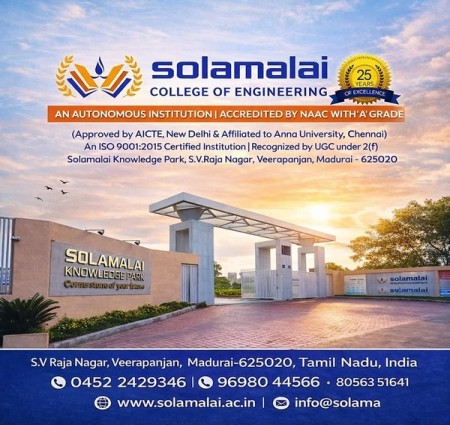
Established in 1995, Solamalai College of Engineering is an autonomous institution in Madurai offering undergraduate, postgraduate and management programmes.
Its undergraduate programmes include Civil Engineering, Computer Science and Engineering, Electrical and Electronics Engineering, Electronics and Communication Engineering, Mechanical Engineering, Artificial Intelligence and Machine Learning, VLSI Design, Artificial Intelligence and Data Science, and Computer Science and Business Systems.
The institution also offers M.E. programmes in Computer Science and Engineering, Embedded Systems, and Soil Mechanics & Foundation Engineering, along with MBA specialisations in five management areas.
The wider lesson is simple: engineering is not one fixed academic route. It is a collection of disciplines that continue to develop as technology, scientific knowledge and practical requirements change. Understanding what each field actually studies can help students approach their higher-education decisions with clearer expectations.
Verified Brand
Solamalai College of Engineering is a well-established institution in Tamil Nadu, known among the best engineering colleges in Madurai for its focus on academic quality, innovation, and career-oriented education. Established in 1995, the college is autonomous and approved by AICTE, ensuring high academic standards and industry relevance.
The college offers a range of undergraduate and postgraduate programs in engineering and management, including Computer Science, Mechanical, Civil, Electronics and Communication, and MBA. Its curriculum is regularly updated to match industry trends, combining theoretical learning with practical exposure through projects and hands-on training.
The campus features modern... Read More
Have a question about this post? Send it straight to the author — only they will see it.
We are accepting Guest Posting on our website for all categories.
I want to Hire a Professional..

Solamalai College
Verified Author Expert@DigitalDiaryWefru