How Does the Crypto Token Development Process Work?
꧁ Digital Diary ༒ Wefru – India's Largest Writing Community ༒ Read, Write & Grow ༒꧂
꧁ Digital Diary ༒ Wefru – India's Largest Writing Community ༒ Read, Write & Grow ༒꧂
Scan QR code to visit our website

Cryptocurrency and blockchain technology have changed how businesses create, manage, and transfer digital assets. Today, companies can use crypto tokens for payments, fundraising, asset ownership, rewards, gaming, and many other purposes. However, creating a successful crypto token requires more than just writing code. It involves proper planning, blockchain selection, smart contract development, testing, and deployment.
This is where a crypto token development company can help businesses turn their ideas into secure and functional digital assets. With the right development approach, businesses can create tokens that support their goals and provide value to their users.
But how does the crypto token development process actually work? Let's explore each step in detail.
Crypto token development is the process of creating digital tokens on an existing blockchain network. These tokens use smart contracts to manage their functions, transactions, and supply.
Unlike cryptocurrencies such as Bitcoin, which operate on their own blockchain, most crypto tokens are built on existing blockchain networks such as Ethereum, BNB Chain, Polygon, and Solana.
Businesses can create different types of tokens depending on their needs, including:
Utility Tokens: Provide access to a product, platform, or service.
Security Tokens: Represent ownership or investment rights in an asset, subject to applicable regulations.
Governance Tokens: Allow holders to participate in project decisions.
Payment Tokens: Enable digital payments and transfers.
Real-World Asset (RWA) Tokens: Represent ownership or rights connected to physical or financial assets.
Gaming Tokens: Support in-game purchases, rewards, and digital economies.
Each token type serves a different purpose, so businesses should define their goals before starting development.
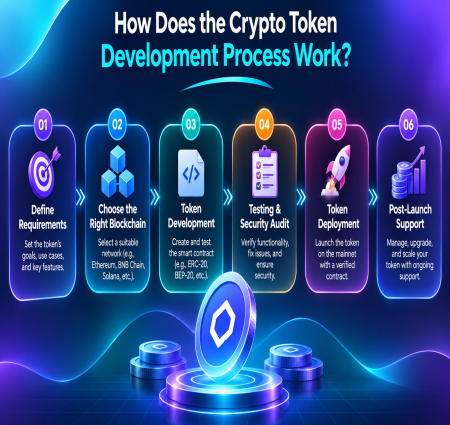
The crypto token development process involves several important stages. Each stage helps ensure that the token works properly, meets business requirements, and provides a secure experience for users.
The first step is to understand why you want to create a crypto token. A clear purpose helps developers choose the right blockchain, token standard, and features.
For example, a business may want to create a utility token for its platform, a governance token for a decentralized community, or an RWA token for representing real-world assets.
At this stage, businesses should decide:
What problem will the token solve?
Who will use the token?
What benefits will token holders receive?
Will the token support payments, rewards, governance, or ownership?
What is the expected token supply?
A clear plan makes the development process easier and reduces unnecessary changes later.
After defining the token's purpose, the next step is selecting a suitable blockchain network. The blockchain determines how transactions are processed, how much users pay in transaction fees, and which token standards are available.
Some popular blockchain networks include:
Ethereum: Widely used for smart contracts, decentralized applications, and ERC-20 tokens.
BNB Chain: Known for its compatibility with Ethereum tools and relatively low transaction fees.
Polygon: Offers scalable blockchain solutions and supports Ethereum-compatible development.
Solana: Designed for fast transactions and supports token creation through its token programs.
Avalanche: Supports custom blockchain networks and decentralized applications.
The right choice depends on transaction speed, development costs, security, scalability, ecosystem support, and project requirements.
A professional crypto token development company can help businesses compare these networks and select the most suitable option.
A token standard defines the rules that a token follows on a blockchain. It helps ensure compatibility with wallets, exchanges, decentralized applications, and other blockchain services.
Some commonly used token standards include:
ERC-20: Used for fungible tokens on Ethereum.
ERC-721: Used for non-fungible tokens (NFTs).
ERC-1155: Supports both fungible and non-fungible tokens.
BEP-20: Used for fungible tokens on BNB Chain.
SPL: A commonly used token standard on Solana.
For example, a business creating a payment or utility token may choose ERC-20, while a project creating unique digital collectibles may use ERC-721.
Selecting the right standard helps the token work smoothly within its blockchain ecosystem.
Tokenomics refers to the economic structure of a cryptocurrency token. It explains how tokens are created, distributed, used, and managed within a project.
A strong tokenomics model helps build trust and supports the long-term growth of the project.
Important tokenomics factors include:
Total Token Supply: The maximum or planned number of tokens.
Token Distribution: How tokens are allocated among the team, investors, community, and ecosystem.
Vesting Period: The schedule for releasing tokens over time.
Utility: The purpose and benefits of holding or using the token.
Burning Mechanism: Whether tokens can be permanently removed from circulation.
Reward System: How users earn tokens through participation or other activities.
For example, a blockchain gaming project may distribute tokens as player rewards, while a DeFi project may use tokens for governance or platform incentives.
Businesses should design tokenomics carefully to avoid unnecessary inflation and maintain a balanced token economy.
Smart contract development is one of the most important stages of crypto token creation. A smart contract is a program stored on a blockchain that automatically executes predefined rules when certain conditions are met.
For a crypto token, the smart contract controls functions such as:
Token creation and total supply
Sending and receiving tokens
Balance tracking
Minting and burning
Ownership and access permissions
Transaction restrictions, where required
Developers usually write smart contracts using languages such as Solidity for Ethereum-compatible networks or Rust for certain Solana programs.
The contract must be developed according to the token's requirements. It should also follow secure coding practices to reduce the risk of vulnerabilities and unauthorized activities.
Before launching a crypto token, developers must test it carefully. Even a small smart contract error can lead to financial losses or unexpected behavior.
Testing helps identify problems before the token goes live on the main blockchain network.
Important testing activities include:
Checking token transfers and balances.
Testing minting and burning functions.
Reviewing access permissions.
Testing smart contract security.
Checking wallet compatibility.
Identifying bugs and performance issues.
Developers often use testnets to check how the token works without using real assets. Smart contract audits can also help identify security weaknesses.
A thorough testing process improves reliability and gives users greater confidence in the token.
Once the smart contract passes testing, it is ready for deployment on the selected blockchain's main network.
During deployment, the smart contract is published to the blockchain and receives a unique contract address. Users can use this address to identify and interact with the token.
The deployment process generally includes:
Final smart contract verification.
Deploying the contract to the mainnet.
Confirming the contract address.
Verifying the contract on a blockchain explorer.
Testing basic token functions after deployment.
After deployment, the token becomes available for use according to its smart contract rules.
A token becomes more useful when users can store, send, receive, and interact with it through compatible platforms.
Wallet integration allows users to manage their tokens. Depending on the project, businesses may also integrate their tokens with decentralized exchanges, DeFi applications, payment platforms, NFT marketplaces, or other blockchain services.
For example, a utility token may be integrated into a business platform so customers can use it to access premium features or services.
These integrations improve accessibility and help build a stronger token ecosystem.
Launching the token is not the end of the development process. Businesses must continue monitoring its performance, maintaining the supporting platform, and addressing technical issues.
Post-launch activities may include:
Monitoring smart contract activity.
Tracking token transactions.
Fixing technical issues.
Updating supporting applications.
Improving security.
Managing community feedback.
Maintaining wallet and platform integrations.
Regular monitoring helps businesses keep their token ecosystem stable and useful as the project grows.
Creating a crypto token requires blockchain knowledge, smart contract expertise, security testing, and proper tokenomics planning. Managing all these tasks without technical experience can be challenging.
Working with an experienced crypto token development company can help businesses:
Choose a suitable blockchain network.
Select the right token standard.
Design a practical tokenomics model.
Develop secure smart contracts.
Test and audit token functionality.
Integrate wallets and blockchain platforms.
Deploy and maintain the token.
A development partner can also help businesses avoid common technical mistakes and build solutions that match their project requirements.
WisewayTec is a blockchain and IT solutions provider offering custom blockchain, Web3, and software development services. The company helps businesses explore blockchain-based solutions and turn their digital ideas into practical products.
With its blockchain development expertise, WisewayTec can support businesses looking to build crypto token solutions based on their specific requirements.
From understanding project goals and selecting suitable blockchain technologies to smart contract development and integration, having the right technical partner can make the development journey more organized.
Businesses planning to launch a utility token, governance token, payment token, or other digital asset can explore custom development solutions that align with their goals.
The crypto token development process involves several stages, starting with defining the token's purpose and ending with deployment, integration, and ongoing maintenance. Each step plays an important role in creating a functional and reliable digital asset.
Businesses should focus on selecting the right blockchain, designing balanced tokenomics, developing secure smart contracts, and testing everything before launch.
Partnering with a reliable Crypto Token Development Company like WisewayTec can help simplify this process and support the development of blockchain-based token solutions that meet business needs.
Wisewaytec is a leading blockchain development company. Our commitment to 100% client satisfaction is evident in the glowing reviews and trust we've earned from top brands. With innovative solutions and a client-first approach, we transform visionary ideas into reality. Join the ranks of our satisfied clients and experience unparalleled excellence in blockchain technology.
 梁永熹区块链 香港顶尖区块链公司与开发者
0 comments · 313 views
Read and comment first →
 CryptoApe New Year Blast: Up to 50% Off on All Blockchain Products
0 comments · 489 views
Read and comment first →
 Website Development Agency vs Freelancers: Which Is Better?
0 comments · 484 views
Read and comment first →
 Why Every Crypto Entrepreneur Should Consider a Trust Wallet Clone Script
1 comment · 484 views
Join the conversation →
 DeFi Development Benefits You Should Know in 2026
0 comments · 469 views
Read and comment first →
Have a question about this post? Send it straight to the author — only they will see it.
We are accepting Guest Posting on our website for all categories.


WisewayTec | Digital Partner For Web3 & Blockchain Solutions
@DigitalDiaryWefru