How CRM Integration Services and Execution Solutions in the USA Will Drive Digital Transformation in 2027?
꧁ Digital Diary ༒ Wefru – India's Largest Writing Community ༒ Read, Write & Grow ༒꧂
꧁ Digital Diary ༒ Wefru – India's Largest Writing Community ༒ Read, Write & Grow ༒꧂
Scan QR code to visit our website

Digital transformation is no longer limited to adopting new software. In 2027, organizations across the United States are expected to focus on connecting business systems, automating workflows, and using artificial intelligence (AI) to turn customer data into actionable insights. This is where crm integrations services & executions solutions in usa become increasingly important. Rather than operating CRM platforms as standalone systems, businesses are integrating them with ERP platforms, marketing tools, customer service applications, supply chain systems, and even legacy environments to create a unified technology ecosystem.
As organizations navigate AI adoption, rising customer expectations, and growing data complexity, CRM integration strategies will play a central role in helping businesses modernize operations and make more informed decisions.
CRM integration refers to the process of connecting a Customer Relationship Management system with other business applications so that information flows seamlessly across departments.
Execution solutions go a step further by ensuring that integrated systems actively support automated business processes, decision-making, and customer engagement workflows.
Common CRM integrations include:
Instead of employees manually updating information across multiple systems, integrations help synchronize data automatically, improving efficiency and accuracy.
Several technology trends are increasing the importance of CRM integrations.
Recent developments in CRM platforms show a clear shift toward AI agents, predictive analytics, and workflow automation. Major CRM providers are introducing capabilities that can automatically qualify leads, summarize customer interactions, generate responses, and recommend next actions.
However, AI systems are only as effective as the data available to them.
If customer information remains scattered across multiple applications, AI-generated insights become incomplete. CRM integrations help create a centralized data environment that allows AI tools to operate more effectively.
Modern customers interact with organizations through multiple channels:
Customers increasingly expect companies to recognize their previous interactions regardless of the channel used.
Proper CRM integration ensures that customer histories remain accessible across departments, creating a more consistent customer experience.
Business leaders increasingly require immediate access to operational data.
Integrated CRM environments can combine information from sales, finance, inventory, customer support, and marketing systems to provide a comprehensive view of organizational performance.
AI is becoming deeply embedded within CRM ecosystems.
Integrated CRM environments can support:
Rather than relying solely on historical reports, businesses can use integrated AI models to anticipate future outcomes.
Organizations are increasingly using cloud-based integration platforms to connect systems without extensive custom coding.
Benefits include:
These platforms allow businesses to integrate CRM systems with both modern cloud applications and older on-premises systems.
Application Programming Interfaces (APIs) have become the foundation of modern integration strategies.
API-driven architectures help businesses:
As businesses adopt additional tools, APIs make future expansion much easier.
Business users increasingly participate in workflow creation through low-code platforms.
This approach enables departments to automate repetitive CRM processes without requiring significant software development expertise.
Manufacturers are integrating CRM systems with ERP and warehouse management platforms to improve coordination between sales teams and operational departments.
This allows organizations to:
Healthcare providers use CRM integrations to coordinate patient communication, appointment scheduling, billing, and service management while maintaining compliance requirements.
Retail businesses integrate CRM platforms with:
This creates more personalized shopping experiences and improves customer retention efforts.
Banks and financial institutions use CRM integrations to combine customer data from multiple channels, improving service delivery, reporting, and compliance management.
While businesses adopt new technologies, many organizations still rely on proven warehouse management environments.
As a result, there remains substantial demand for:
Large distribution centers, manufacturers, and logistics providers continue using AS400 PKMS systems because of their stability and operational reliability.
In 2027, many digital transformation initiatives will focus not on replacing these systems entirely but on integrating them with modern CRM, ERP, analytics, and AI platforms.
This hybrid approach allows organizations to preserve existing investments while gaining access to modern capabilities.
Integrated systems reduce duplicate data entry and minimize inconsistencies across departments.
Business leaders can access information from multiple systems through a single interface, helping them make decisions more quickly.
Employees gain access to complete customer records, enabling more informed interactions.
Automation eliminates repetitive manual work and reduces administrative burdens.
Integrated systems provide more comprehensive reporting by combining information from various business functions.
Despite the advantages, CRM integration projects are not without obstacles.
Poor-quality data remains one of the biggest barriers to successful integrations.
Organizations should establish governance processes before launching integration initiatives.
Many companies continue to operate older applications that were not originally designed for modern integration methods.
Additional customization may be required to connect these systems effectively.
Integrated environments involve larger volumes of shared data.
Businesses must implement:
Successful CRM integration requires employee adoption.
Organizations should provide training and establish clear workflows to ensure long-term success.
Technology decisions should support measurable business goals rather than simply following trends.
Clean and reliable data should be established before integrations are deployed.
Integration strategies should accommodate future growth and additional applications.
Security requirements should be built into the architecture from the beginning rather than added later.
Organizations should track key performance indicators such as:
By 2027, CRM systems are expected to evolve from customer databases into intelligent business orchestration platforms.
Organizations will increasingly combine CRM solutions with AI, automation, analytics, ERP platforms, supply chain systems, and warehouse management technologies to create connected digital ecosystems. Companies investing in crm integrations services & executions solutions in usa will likely focus on unifying data, automating processes, and improving visibility across business operations rather than merely implementing another software platform.
At the same time, legacy environments will remain important. Organizations using as400 pkms implementation services in usa, as400 pkms support services in usa, and broader as400 pkms services in usa will continue integrating these proven systems with modern CRM technologies to balance innovation with operational stability.
Digital transformation in 2027 will be driven less by individual applications and more by how effectively business systems work together. CRM integration strategies will become a critical foundation for AI adoption, workflow automation, customer experience improvement, and data-driven decision-making.
Organizations that approach CRM integration thoughtfully, with attention to data quality, security, scalability, and long-term business goals, will be better positioned to adapt to changing customer expectations and an increasingly connected digital economy.
Verified Brand
SourceMash is a trusted AI Digital Product Engineering consulting company in the USA that helps organizations accelerate digital transformation through innovative, scalable, and results-driven technology solutions. The company specializes in artificial intelligence, generative AI, data analytics, enterprise applications, cloud technologies, cybersecurity, DevOps, and digital product engineering, enabling businesses to streamline operations, improve decision-making, and drive long-term growth.
Have a question about this post? Send it straight to the author — only they will see it.
We are accepting Guest Posting on our website for all categories.
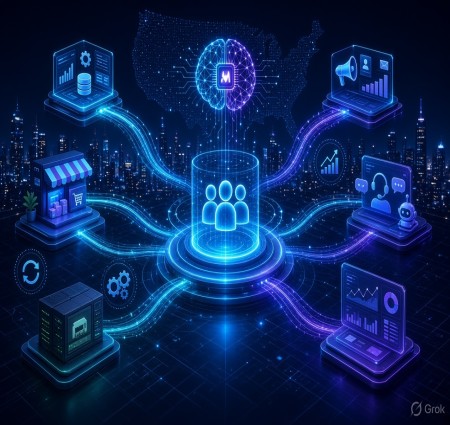

AI Digital Product Engineering consulting company
Verified Author Expert@DigitalDiaryWefru