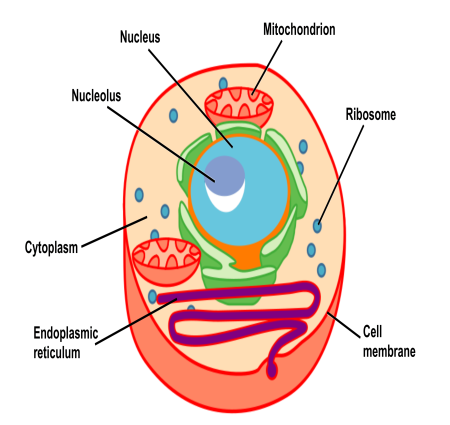
Nucleus:- Different parts of the cell are colored in different colors depending on their chemical composition. Some areas appear darker and some lighter. In addition to iodine solution, we can also use fardin or ????????? blue solution to color the cells.
Cytoplasm:- When we looked at slides of onion slices and human cheek cells, we saw a large area in each cell that was surrounded by a cell membrane. There are very few dhabas in the area. This is called ?????????.
Endoplasmic Reticulum(ER):- The Endoplasmic Reticulum is a large system of membrane-bound tubes and sheets. These resemble long tubes or round or rectangular sacs (vesicles). There are two types of Endoplasmic Reticulum; Rough Endoplasmic Reticulum (RER) and Smooth Endoplasmic Reticulum (SER).
Golgi Apparatus:- The Golji Apparatus, described by Comillo Golji, is a system of membrane-bound flat vesicles arranged parallel to each other, which are called vesicles. These membranes are in contact with the ?? membranes and hence form the second part of the complex cellular membrane system.
Lysosome:-Lysosomes contain very powerful digestive enzymes which break down complex substances into simpler substances. When a cell becomes weak or dead due to disruption in cellular Metabolism, Lysosomes burst and enzymes destroy their own cells. Therefore Lysosome is also called 'Suicide Bag' of the cell.
Mitochondria:- Mitochondria are the power house of the cell. Mitochondria are made of double membrane. The outer membrane is porous and the inner membrane is highly folded. Mitochondria are very amazing organelles because they contain their own DNA and cytosomes. Therefore, mitochondria make some of their own proteins.
Playstid:-Plastids are located only in plant cells. There are two types of plastids; Chromoplast (coloured plastids) and Leucoplast (white and colored plastids) The chromoplast which contains chlorophyll pigment is called chloroplast. Plastids are like mitochondria in external structure. Like mitochondria, plastids also have their own DNA and ribosomes.
Vacuoles:-Vacuoles are storage sacs of solid or liquid substances. The vacuoles in animal cells are small, whereas the vacuoles in plant cells are very large. Therefore, the cell is a basic structural unit of living organisms. It is also a basic functional unit of life.
FAQ
No FAQ Available.
Leave a comment
We are accepting Guest Posting on our website for all categories.




Fariya
@DigitalDiaryWefru